![]() |
Sign In or Register | Contact us Have Questions? Call Us: 330-491-1905 |
Check out this column protector applcation video on You Tube
http://www.youtube.com/user/IdealShield
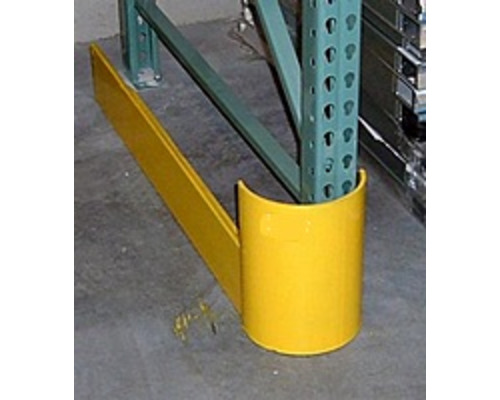
Applies to our HGR series , SGR series, and Vehicle Stopper Series of Rail Barrier Products.
Some additional applications for Bumperwrap™, an easy way to protect your facility and eliminate paint touch ups. Whether it's a column, pipe, or whatever you can get around.
Step One – Measure the circumference of the object that you wish to wrap.

Step Two – Measure length of Bumperwrap™ to match the circumference of
the object, and cut to the determined length. A sharp utility knife or
heavy-duty scissors will work well for cutting Bumperwrap™. For best
results, use a metal framing square or similar tool to ensure a square cut.
Check the length by wrapping the cut piece tight around the object,
leaving ½” gap for the fasteners. When wrapping the same size object in
several applications, complete first installation to check for a good fit.

Step Three - Feed the fasteners through Bumperwrap™. Four straps or cable ties are recommended for most applications. On small poles, more fasteners may be required. For installations of 48” or less, use heavy duty cable ties. For longer installations use ½” pallet banding (plastic strap and buckles).
(Silicone spray can be used to aid in sliding the attachment banding into Bumperwrap™)

Step Four – Apply the material at the optimum height for vehicle protection
and visibility. Multiple layers of 12” Bumperwrap™ can be applied to
achieve 24” or more of protection.
Great picture of Door Track Protector in use. Save door maintenance dollars by isolating impacts from overhead door tracks!

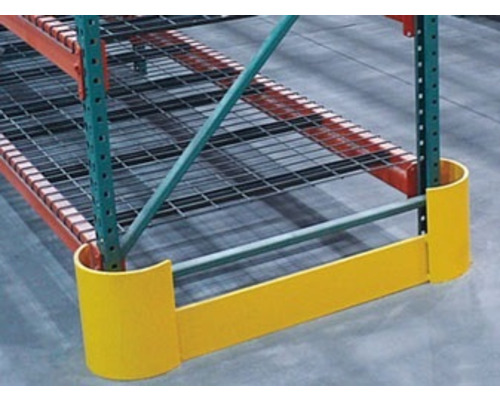
Good rack guards might have prevented the disater in this film. Luckily the driver got away!
http://www.break.com/index/worker-dodges-huge-warehouse-collapse.html
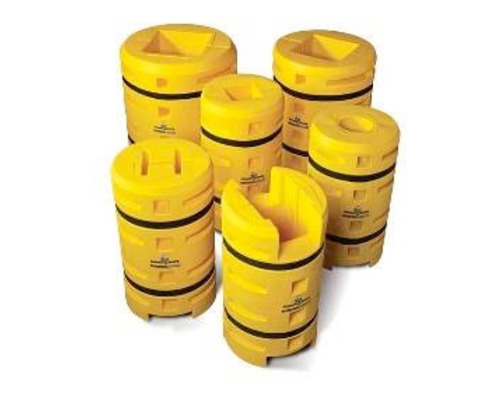
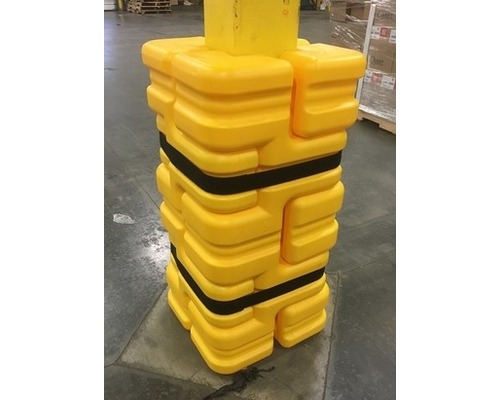
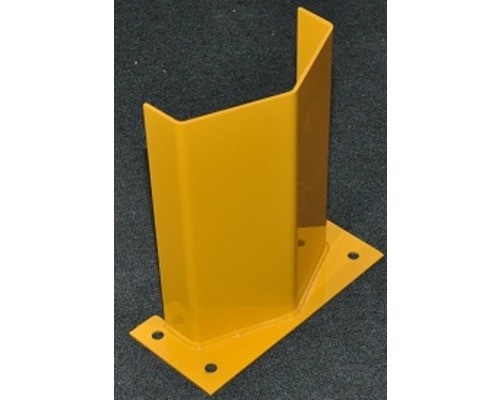
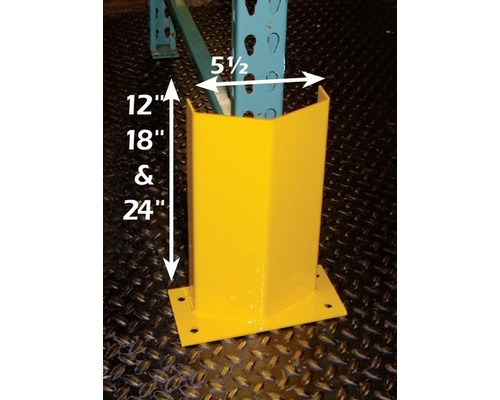
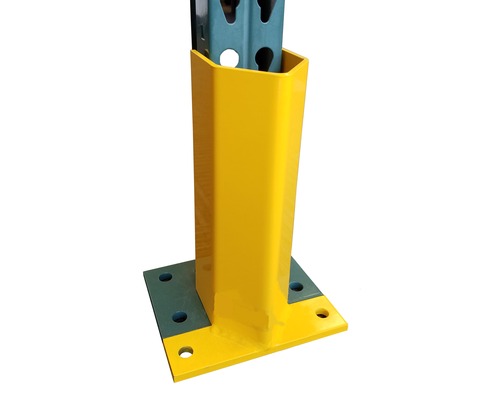
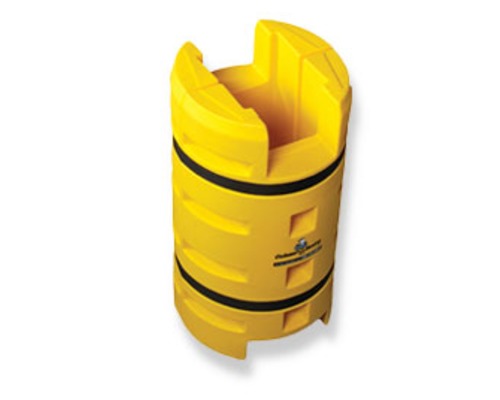
Note this universal column protector model only requires two(2) anchors to complete its installation. Beyond the cost (included) of the anchors, half as many holes, nuts to be tightened, etc.; in today's economic environment that's a savings to be considered.
When installing your bollards, plan your escape. Or do you think these are removable bollards?
From Andrew Jordan of Rack Protect:
Rack Armor may look like a piece of plastic tube with foam stuck in it, but the more you learn about the physics of it the more impressed you will be.

1. It's round. When you try to hit it with a fork it's difficult. The fork tends to judder on the carriage and slide away.
2. The point impact. When forks hit a solid object like rack they do a lot of damage.This is because all the weight of the truck, is concentrated into one little area, the tip of the fork. Assuming 4,000 lbs concentrated into a 6" x 1/8" Tip it equals 3,000 lbs per square inch. To give a comparison your bedroom floor is 40 lbs per square foot and above ground swimming pool is 500 lbs per square foot. So it really is a tremendous force. What Rack Armor does is un concentrate this force again. By spreading out the force over the entire length of the Hard Outer Shell, it makes a small impact spread out and lessen into a larger diffused impact. From 1/8" to 24" is a 1 to 192 diffusion ratio, or to put it another way it increases the small area by 19,000%
imagine a shovel hitting something with the pointed end. Very hard, painful and all the force is concentrated in that small lip. Now take that same shovel and hit something with the flat part, same energy and force but much less damage.
That is what Rack Armor does with impacts, it spreads them out along the surface of the outer shell making them much less harmful.
3. By bending the shell and allowing the motion to continue, it allows the impact to slow and stop. Compare a mountainside road truck run out, with the bed of gravel to the truck hitting a cement wall. With the gravel the truck continues but slowly decelerates and comes to a stop with no damage. With a cement wall, all the kinetic energy is released into metal deformation,heat and complete damage. The combination of the outer shell slowly bending and the foam absorbing is like the bed of gravel
Finally any remaining energy is absorbed into the foam. Pictures show the Rack Armor being pushed back as far as 1" on the column but not transferring the impact to the column.
Most of our documentation and testing, shows a fork impacting the Rack Armor repeatedly in the same place at a simulated 4 mph. This is not a real life situation, it is much harsher. Most real life bumps occur at 2-3 mph with a loaded pallet. Usually when the driver is trying to put away a pallet. In checking with customers who have had Rack Armor for some time they usually do not have any comments. This is because it is doing it's job 24/7. If it was not we would be hearing all manner of complaints. We have received no complaints from any of our customers, about the performance of the Rack Armor.
FREQUENTLY ASKED QUESTIONS![]()
The following section lists frequently asked questions relating to Protect-it MAXI™ structural column guards. If you have any further questions then please don't hesitate to contact us.
When should I replace Protect-it MAXI™?![]()
![]()
The frequency of replacement will depend on your forklift drivers – always encourage them to drive responsibly!
All impact protection devices must deform in order to absorb impact energy. For light to medium impacts Protect-it MAXI™ column guards return to their original shape. In more serious impacts Protect-it MAXI™ column guards(as with all well designed protection devices, plastic or metal) may deform irreversibly or even fracture to protect the column. When this happens, they should be replaced immediately. ![]()
Is plastic strong enough?![]()
![]()
Yes! We use a special grade of HDPE combined with special additives to make it super tough. Our column protectors have established a reputation throughout the world for impact strength in a wide range of extreme environments from Arctic winters to Australian summers.![]()
How do Protect-it MAXI™ column guards compare to other plastic guards?![]()
![]()
Most plastic competitor products are made from LDPE using the rotational moulding process. This material becomes brittle in below zero temperatures. Protect-it MAXI™ column protecotrs are injection moulded allowing us to use much tougher HDPE plastic materials with special additives and capable of performing in temperatures as low as -40’C. ![]()
What about safety inspections?![]()
![]()
We recommend regular inspections and immediate replacement if permanent deformation or breakage is observed after an impact.
Removal of a single connection pin enables Protect-it MAXI™ column protector to be removed from the column, allowing safety inspectors to conduct fast and effective visual inspections. Once this is done Protect-it MAXI™ column guards can be re-installed in seconds by reversing the procedure. We advise that you check the safety standards in your region.![]()
Is Protect-it MAXI™ easy to install?![]()
![]()
Protect-it MAXI™ is supplied in a pack of 20 individual Protect-it MAXI’s and 8 connecting pins. This is called a MAXIPAC weighing only 8.2kg (18lbs). The pack size allows one person to create a column protector to suit your own specific needs in minutes, irrespective of the column size or shape, and without exceeding safe work practices for manual lifting. The larger the column, the more MAXIPAC’s required.
You may want to print this picture to facilitate installation of your Protect-it™ MAXI column protectors.
Manufacturer Links |
Call Ken Welch at 330-491-1905 for immediate assistance.
Fax: 877-843-0592 or Contact us
Privacy Policy | Terms and Conditions | Copyright Notice
Column Protectors, brought to you by Indoff Inc.
Copyright © 2010 Indoff Inc. All Rights Reserved